AI Throughput Needs Visible Work
Why AI engineering throughput depends on tasks, pull requests, CI evidence, review gates, and artifacts teams can measure.
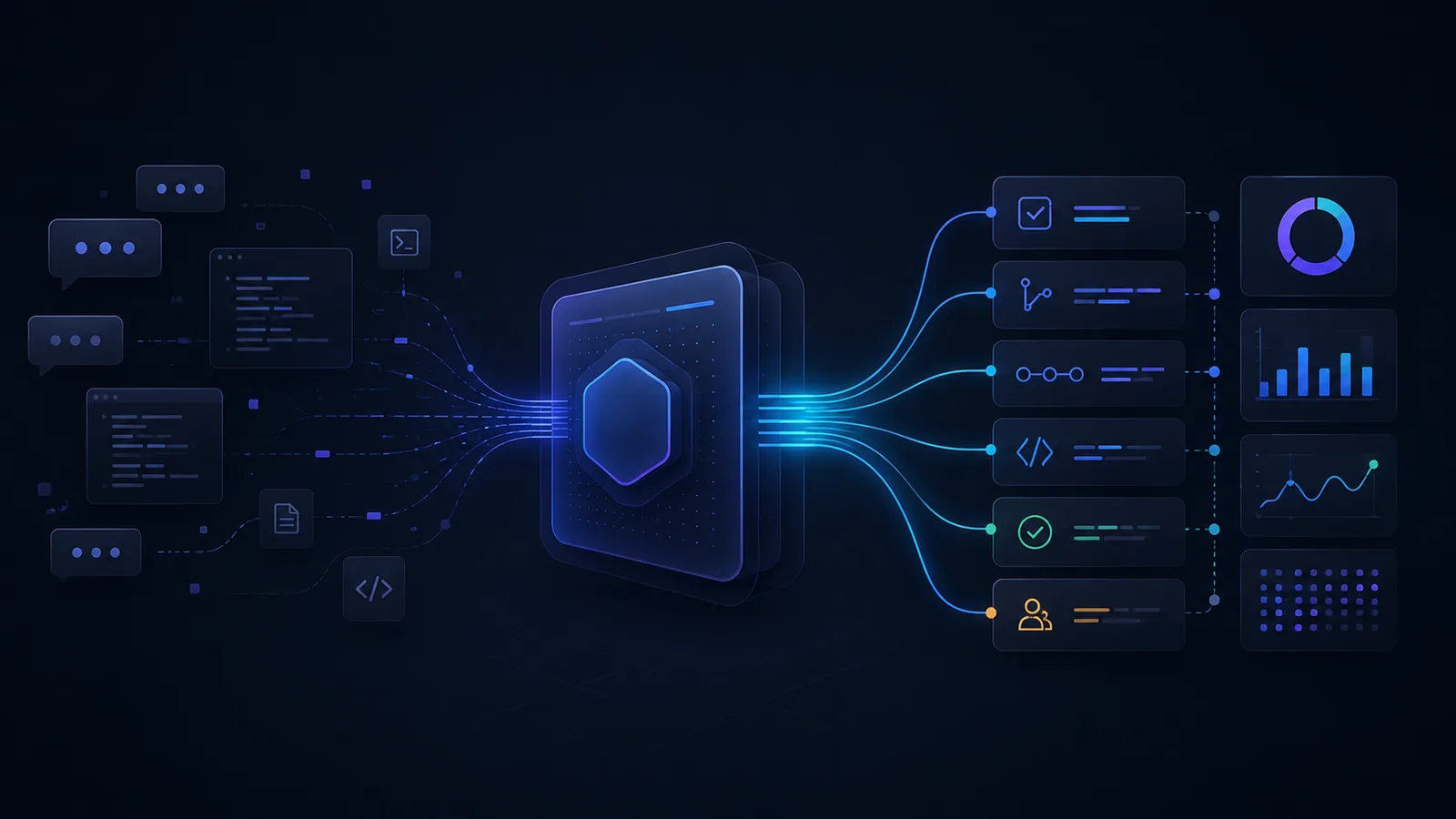
AI engineering throughput does not come from private coding sessions alone. It comes from work that moves through shared systems: tasks, branches, pull requests, CI checks, and human review.
AI engineering throughput is not the same thing as individual developer productivity.
That distinction matters because most companies still evaluate AI coding tools through an individual lens: does this make one developer faster, less blocked, or more productive inside an editor? Those are useful questions. They are not the whole business question.
The harder question is whether AI-assisted work becomes company-visible output: assigned work, repository changes, pull requests, CI evidence, review decisions, and delivery metrics the team can manage.
Private AI usage can help a developer. A company cannot manage private speed. It can only manage work that moves through shared systems.
useful but local
fast for one person
not yet reviewable
bounded work
isolated change
review surface
validation result
human decision
measurable result
What you should take away
- Individual AI productivity is useful, but it is not the same as team throughput.
- Company-visible AI work should leave normal engineering artifacts: task, branch, commits, pull request, CI evidence, and review decision.
- Forkline runners are built for bounded execution that stays inside Git workflows instead of private chat sessions.
- ROI should be measured through checkpoints and reviewable outcomes, not broad productivity percentages.
- BYOM keeps model choice separate from runner execution so teams can reason about economics and workflow separately.
Individual productivity is only the first layer
AI coding assistants are useful because they reduce friction at the point of work. They can help write a test, explain a failing build, suggest a refactor, or turn vague context into a concrete patch.
For an individual developer, that can be enough. If the tool helps them move faster, the value is felt immediately.
For a team, the value is more complicated. The company still needs to know:
- what work was assigned
- whether the work produced a branch, commit, or pull request
- whether CI or repository validation passed
- what the reviewer had to inspect
- whether the change was merged, revised, or rejected
- whether similar work can be routed through the same process again
Without those checkpoints, AI productivity remains mostly private. It may improve morale or reduce local friction, but it is hard to connect to throughput, maintenance, or planning.
That is the gap Forkline is built around. Forkline gives small teams and companies AI runners for engineering work: bounded execution that produces reviewable branches, commits, pull requests, runner summaries, model attribution, and CI evidence where applicable.
The goal is not to replace developers. The goal is to move AI work into the same workflow layer where engineering teams already coordinate and review work.
The company-level ROI question
It is possible for an AI tool to be individually worthwhile while still being hard to measure at the company level.
A simple example shows the difference. If a company pays for AI tools across many developers, the individual ROI question might be: does each person save enough time to justify the subscription? For a $100/month tool, only a small productivity lift can make the arithmetic look reasonable for one developer.
But that does not answer the management question. The company still has to ask whether the lift becomes more reviewed, shipped, maintained software.
If the productivity gain stays inside private chat sessions, local editor workflows, or untracked spare time, the company has limited visibility. The tool may still be valuable, but the organization cannot easily steer it, measure it, or improve the workflow around it.
That is why AI runner ROI should be framed around checkpoints rather than broad productivity percentages. Before claiming that AI increased output, a team should be able to inspect the work path:
- A ticket, issue, or bounded task defines the work.
- A runner executes the task in an isolated environment.
- The result lands as Git artifacts: branch, commits, and pull request.
- CI or repo checks run where applicable.
- A human reviews the change and makes the final decision.
- The workflow records enough context to learn from the result.
Those checkpoints do not prove ROI by themselves. They make ROI measurable.
Why private sessions do not compound
Private AI sessions can be productive, but they rarely compound across a team.
If one developer uses an assistant to debug a CI failure, the result may be a fixed branch. But unless the diagnosis, change, validation, and review path are visible, the team learns little about whether similar failures can be handled the same way next time.
If one developer uses an assistant to update a dependency, the team still needs to know whether the migration handled breaking changes, whether tests passed, and whether the reviewer had enough context to trust the diff.
If one developer uses an assistant to generate a feature patch, the output still has to pass through architecture judgment, code review, CI, and product fit.
The company does not need every private prompt. It does need durable artifacts. The useful record is not a transcript of the agent’s thinking. It is the normal engineering work trail: task, branch, commits, PR, runner summary, model attribution, CI evidence, and review decision.
That is what lets teams compare work items, improve prompts or task definitions, adjust trigger policies, and decide which categories of work are good candidates for runners.
AI runners turn work into artifacts
An AI runner is useful when it behaves less like a private assistant and more like visible execution capacity.
In Forkline’s model, work starts from a bounded task or issue. The runner executes inside an isolated environment, produces repository changes, and sends the result back through Git-native workflow surfaces. Humans keep the final review and merge decision.
That model changes the unit of measurement.
Instead of asking, “Did the AI make someone faster?” a team can ask more concrete questions:
- How many bounded tasks reached reviewable PRs?
- Which runners produced changes that passed CI?
- Which categories of work required repeated human correction?
- Which model or provider was used for a given runner?
- Where did review burden increase or decrease?
- Which tasks should remain human-only for now?
Those are operational questions. They are also safer than generic productivity claims, because they are tied to artifacts a team can inspect.
Forkline’s current public proof is strongest for issue-driven work, maintenance flows, CI recovery, and reviewable PR artifacts. For example, the promrail CI recovery PR shows a failed GitHub Actions run becoming a reviewable fix with commits and CI evidence. The kaniop Gateway API PR shows a larger feature and CI-fix loop where runner work moved through commits, review, and validation.
Neither example should be stretched into a universal ROI benchmark. They are proof of the artifact shape: bounded work, visible changes, validation, and human control.
What to measure before claiming ROI
Teams should be careful with AI productivity claims. A percentage can sound precise while hiding the actual workflow cost.
A better measurement plan starts with specific work categories and visible checkpoints.
For each AI-runner workflow, measure:
- Time from task to reviewable PR: how long it takes for assigned work to become inspectable.
- CI recovery time: how long failing checks take to reach a candidate fix.
- Review effort: how much human attention the PR requires before approval, revision, or rejection.
- Merge rate by task type: which categories reliably produce acceptable work.
- Iteration count: how often the runner needs additional attempts or human correction.
- Model/provider used: which configured model produced the work, captured through model attribution.
That gives a company a practical ROI framework. The point is not to claim that every runner saves time. The point is to separate work that is ready for runner execution from work that still needs human-first judgment.
Good AI adoption should make that distinction clearer over time.
BYOM matters for throughput economics
Throughput is also an economics problem.
If every automation is bundled into another premium model seat or opaque usage layer, teams may ration the work before they understand what is useful. Forkline’s approach is to separate runner execution from model inference: Forkline bills for runner execution hours, while model usage remains with the provider the team chooses through BYOM.
That distinction matters because the company workflow should survive model-provider changes. Teams may use GitHub Copilot where configured, OpenAI, Anthropic via API key, local models where configured, or other API-supported providers. The runner workflow should be the stable layer around tickets, repos, PRs, CI, and review.
BYOM does not eliminate model costs. It makes the boundary clearer. The company can reason about runner capacity separately from model choice.
For technical founders and engineering managers, that is the useful planning unit: affordable execution capacity that can be routed through shared workflow, inspected by humans, and improved over time.
What this means for engineering leaders
If you are evaluating AI coding tools for a team, do not stop at individual productivity.
Ask how the work becomes visible:
- Does the task enter through a system the team already uses?
- Does the output land as a branch, commit, or PR?
- Does the runner produce a summary that helps reviewers inspect the result?
- Can the team see which model produced the work?
- Does CI or repository validation run where relevant?
- Does a human keep the final gate?
- Can you compare outcomes across work categories?
Those questions are less exciting than broad AI productivity claims. They are also more useful.
The companies that capture AI value will not be the ones with the most private assistant sessions. They will be the ones that turn AI-assisted work into visible engineering throughput: assigned, executed, reviewed, validated, and improved inside the workflow.
The bottom line
Individual AI productivity matters, but it is only the first layer.
For a company, the real value comes when AI-assisted work becomes company-visible engineering throughput. That requires checkpoints: tickets or bounded tasks, runner execution, Git artifacts, pull requests, CI evidence, runner summaries, model attribution, and human review gates.
Forkline is built for that shift. It gives engineering teams AI runners that turn bounded work into reviewable artifacts while keeping model choice, workflow visibility, and human control intact.
If your team is already paying for AI, the next question is not only whether developers feel faster. It is whether that speed turns into work the company can see, validate, and manage.
Start small: sign in at app.forkline.dev, connect one repository, and give a runner a bounded task that can be reviewed like any other pull request.