Ticket-driven AI Automation
How engineering teams can turn bounded issues into AI runner work that produces reviewable branches, pull requests, CI evidence, and human-controlled merge decisions.
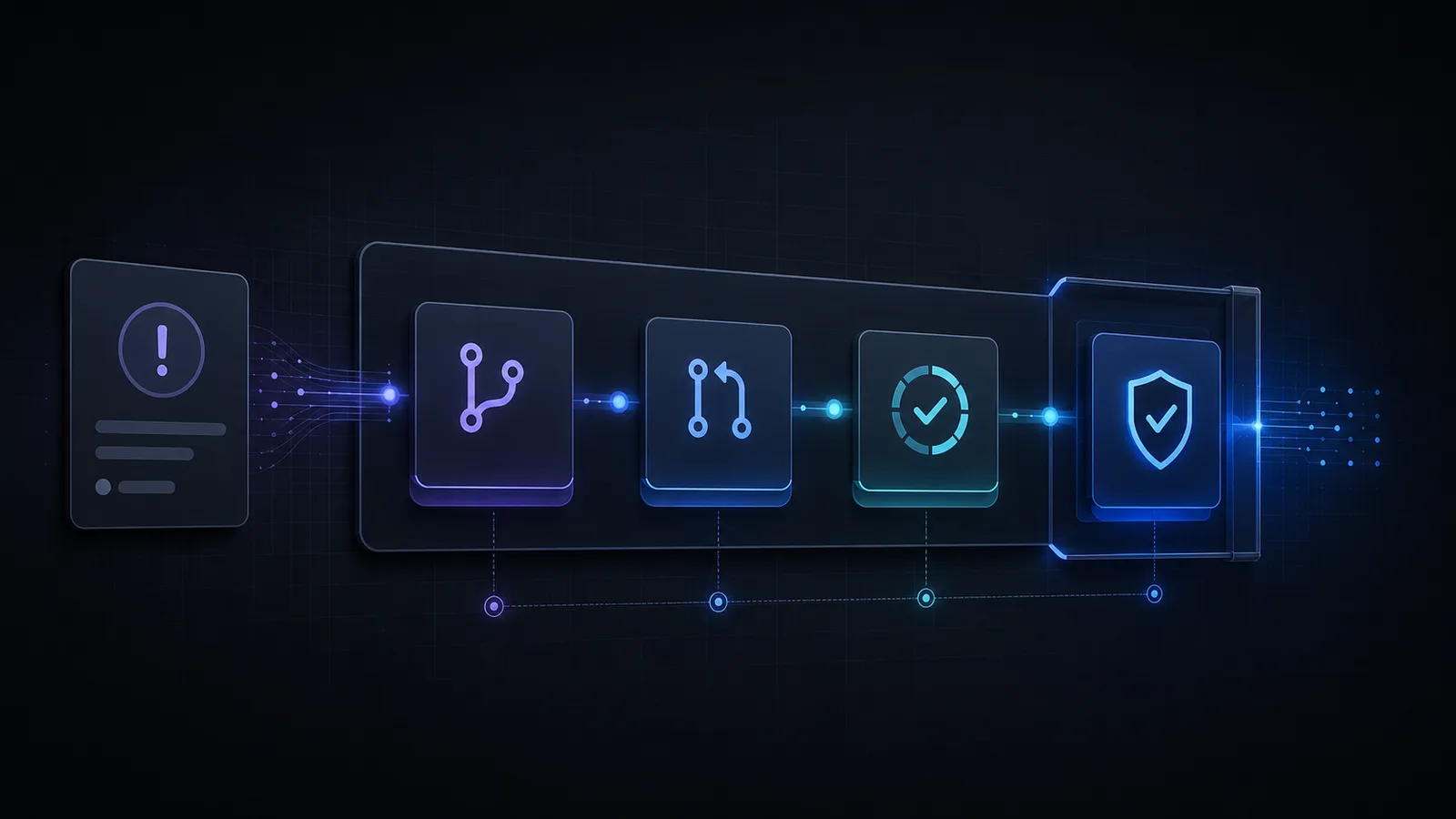
Ticket-driven AI automation only works if the work stays inside the systems the team already trusts. The useful path is not prompt to answer. It is issue to branch to pull request to CI to review.
Ticket-driven AI automation only works for engineering teams if the work stays inside the systems the team already trusts.
That sounds obvious, but it is where many AI coding workflows break down. A private prompt can help one developer move faster. It can explain code, generate a patch, or propose a test. But an engineering manager is not only trying to make one developer faster. They are trying to move team work forward without losing visibility, review discipline, or delivery control.
For that, the unit of work matters. The useful path is not prompt to answer. It is issue to branch to pull request to CI to review.
That is the operating model Forkline is built around: AI runners for engineering teams. A runner takes bounded work from a shared workflow, executes inside a repo, leaves reviewable Git artifacts, and gives humans the final decision.
This post walks through the workflow model and the checkpoints that make ticket to PR automation useful instead of noisy.
Why tickets are a better assignment layer than private prompts
Private prompts are flexible, but they are weak coordination artifacts.
They usually live in one developer’s chat history. They may not include acceptance criteria. They may not map cleanly to the backlog. And after the agent produces a response, the rest of the team often sees only the final patch, if they see anything at all.
Tickets and issues are different. They already carry the context teams use to coordinate engineering work:
- what problem needs to be solved
- why the work exists
- which repo or component is affected
- what constraints or acceptance criteria matter
- who should review the result
- whether the work is ready to merge, revise, or reject
That makes the ticket a natural assignment layer for AI runners. The runner should not be a hidden assistant working from a private conversation. It should be a visible execution worker taking bounded work from the same workflow humans use.
In Forkline’s current public capability set, this is Git-native. Forkline supports GitHub, GitLab, Gitea, and Forgejo workflows. Jira and Linear are roadmap / coming soon integrations, so public content should not describe them as available today. The practical near-term model is simple: use issues, tasks, and Git provider workflow surfaces as the intake and verification layer.
The workflow: issue → runner → branch → PR → CI → review
A useful AI ticket automation flow has six checkpoints.
1. Start with a bounded issue
The issue should be specific enough for a runner to execute and specific enough for a human to review.
Good runner tasks look like normal engineering work:
- fix a failing workflow caused by a dependency update
- add a small feature behind an existing interface
- update a dependency and handle breaking API changes
- add a missing test around a known behavior
- apply a configuration change across a chart, manifest, or package
- investigate a build failure and propose the smallest safe fix
Weak runner tasks are usually too broad:
- improve the whole codebase
- refactor everything
- make this production-ready
- modernize the app
- fix all technical debt
The difference is not whether the AI runner is capable. The difference is whether the team can verify the result. Bounded issues create reviewable work. Unbounded tasks create ambiguity.
2. Let the runner execute in an isolated environment
Once the task is assigned, the runner should work in an isolated environment rather than on a developer’s local machine. That keeps the execution layer separate from private workstation state and makes the output easier to reason about.
Forkline runners are designed for bounded repo work. They execute the task, prepare changes, and leave normal Git artifacts: branches, commits, pull requests, runner summaries, and CI evidence where applicable.
The point is not to expose every internal thought or every intermediate tool call. Forkline deliberately does not retain the full agent conversation, chain-of-thought, tool-call traces, streaming runner output, or per-step runtime records. The useful product-side artifacts are narrower:
- the task input
- the runner summary
- the model audit
The deeper verification happens in the repo: diff, commits, PR discussion, CI checks, and human review.
3. Land work as a branch and pull request
AI work should not skip the team’s normal review surface.
For engineering teams, the pull request is the right handoff point because it combines several signals in one place:
- the proposed code change
- the commit history
- the task or issue reference
- CI status
- reviewer discussion
- the final merge or close decision
This is why ticket to PR automation is a better mental model than prompt to patch. A patch in a chat is still private work until someone manually moves it into the repo. A PR is already in the team’s shared workflow.
A runner-created PR does not mean the work is correct. It means the work is reviewable.
That distinction matters. Reviewable AI work is work the team can inspect, test, reject, revise, or merge through the same controls it already uses for human-authored changes.
4. Use CI as a checkpoint, not a decoration
CI is one of the clearest ways to turn agent output into team-visible evidence.
If a runner changes code, dependencies, build files, generated assets, manifests, or tests, the relevant checks should run. Passing CI does not prove the change is right, but failing CI gives the runner or the team a concrete signal to act on.
This feedback loop is one of Forkline’s strongest public proof areas. For example, forkline/promrail#43
documents a full autonomous feature workflow: issue, planning, implementation, review, three CI fix
iterations, and merge. The approved proof inventory describes it as a complete issue-to-PR workflow with
multiple Rust files changed, tests included, and CI iterations handled before merge.
Another proof point, forkline/promrail#38, shows CI recovery on a Renovate-caused GitHub Actions
failure. Forkline fixed the immediate non-existent action tag and also replaced a deprecated action. That
is a narrower CI recovery example, but it demonstrates the same operating principle: the runner’s work
must come back through observable repo checks.
The lesson is not that every task should be auto-fixed forever. The lesson is that CI gives ticket-driven AI automation a feedback loop the team can trust more than a confident generated explanation.
5. Review the summary against the artifacts
The runner summary should help the reviewer start faster, not replace review.
A useful summary answers practical questions:
- what task was the runner responding to?
- what did it change?
- why did it choose that change?
- what checks or evidence should the reviewer inspect?
- what limitations or follow-up risks remain?
The summary should then be compared against the PR itself. If the summary says it updated a dependency, the diff should show that. If it says tests were added, the files should show those tests. If it says CI passed, the PR checks should show the current state.
Forkline’s ingress-nginx#76 proof is a good runner-summary example. Forkline added a focused security
dependency update inside a Renovate PR and left a concise bot summary explaining what changed:
golang.org/x/net moved from v0.54.0 to v0.55.0 because of GO-2026-5026. The PR retained normal GitHub
artifacts: commit, checks, conversation, and merge record.
That example should not be overstated. It was a runner-summary and dependency-maintenance example, not a deep CI recovery loop or a human merge-gate proof. Its value is more specific: it shows the kind of summary reviewers can verify against normal Git artifacts.
6. Keep the human gate
Ticket-driven AI automation is useful because it can move routine work forward. It is risky if it tries to erase human responsibility.
For teams, the final gate should remain human unless a workflow is explicitly trusted and scoped for automation. The reviewer decides whether the PR is correct, whether the risk is acceptable, whether more tests are needed, and whether the work should merge.
That is especially important for engineering managers. The goal is not to increase the number of random PRs the team must inspect. The goal is to create a controlled path where AI runners handle bounded work and return it in a form the team can evaluate quickly.
Good human-controlled automation has clear boundaries:
- who can trigger runner execution
- what task types are allowed
- how many attempts are reasonable
- which checks must pass
- who reviews the work
- when the runner should stop and ask for human intervention
Forkline supports trigger policies, bounded tasks, isolated runners, PR artifacts, runner summaries, model audits, CI validation where applicable, and human review gates. Those controls are what separate workflow automation from black-box autonomous output.
A practical checklist for ticket to PR automation
Before assigning an issue to an AI runner, use this checklist.
Scope
- Is the issue specific enough to execute?
- Does it name the affected repo, package, workflow, or component?
- Are there acceptance criteria or review expectations?
- Is the expected change small enough to review in one PR?
Execution
- Will the runner create a branch and PR rather than only return a patch?
- Is the task suitable for an isolated runner environment?
- Are model choice and runner execution boundaries clear?
Evidence
- Which tests or CI checks should run?
- What artifact should prove the work happened?
- Does the runner summary describe the change in a way reviewers can verify?
- Is the model audit available for the runner?
Review
- Who owns the final decision?
- What would make the reviewer reject or revise the PR?
- Should the runner attempt CI fixes, or should it stop after the first failure?
- Does this task need manual domain judgment before merge?
This checklist keeps AI ticket automation practical. It makes the work small enough to execute, visible enough to inspect, and bounded enough to govern.
What this changes for engineering teams
The important shift is not that AI can write code. Developers already know that.
The shift is that AI work can become part of the company workflow. Tickets become assignments. Runners execute bounded tasks. Repos hold the artifacts. CI validates what it can. Humans review and decide. The workflow gets a visible update instead of a private chat transcript.
That is where AI runners become useful to engineering managers. They create a way to move routine work forward without asking the team to trust hidden sessions or manually translate private AI output into reviewable engineering work.
Forkline’s current public proof is strongest for issue-driven work, maintenance flows, CI recovery, and reviewable PR artifacts. That is enough to support a practical starting point: use AI runners for bounded Git-native work where the output can become a branch, PR, CI result, runner summary, and review decision.
Conclusion
Ticket-driven AI automation should not mean handing a vague backlog to a black box.
It should mean turning bounded issues into visible engineering artifacts: runner execution, branches, commits, pull requests, CI checks, runner summaries, model audits, and human review.
That workflow gives engineering teams the control they need. The runner moves work forward. The repo keeps the evidence. CI provides feedback. Humans keep the final gate.
If your team is already using GitHub, GitLab, Gitea, or Forgejo, the starting point is not a new abstract AI process. It is the workflow you already have: issue to PR to CI to review.
Forkline adds AI runners to that path.
Learn more at forkline.dev.